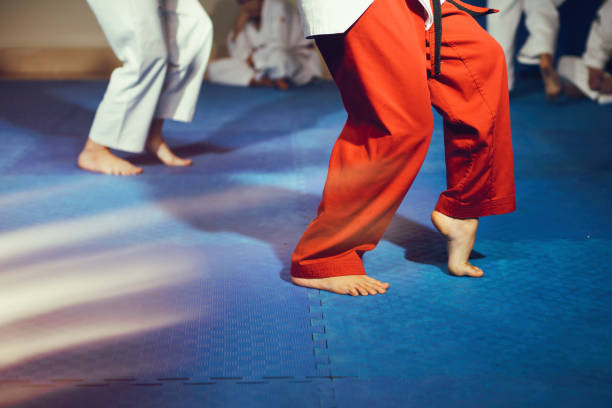
A judo training floor has to cope with thousands of ordinary contacts, not just the occasional dramatic throw. Students kneel, pivot, grip, sweep, fall and stand repeatedly through a session, while instructors need a surface that remains predictable from one class to the next. Choosing the floor system therefore requires a balance between impact management, stability, durability and practical maintenance.
Impact behaviour is the obvious starting point. Throws can place substantial force through the body, so the surface needs to provide suitable cushioning for the level and type of training. Thickness by itself is not enough to judge performance. Foam construction, density, backing and the floor beneath the mat all affect how a landing feels. Judo mats should be assessed as part of a complete installation rather than as isolated pieces.
Stability matters just as much. A surface that compresses deeply or shifts during movement can make footwork less predictable. Judo involves rapid direction changes, sweeps and close contact, so athletes need enough grip to move with control without feeling that their feet are stuck to the surface. The preferred texture may also depend on cleaning needs and the style of training used at the club.
The subfloor should be considered before products are compared. Mats placed directly on concrete can behave differently from the same mats over a sprung or shock-absorbing system. Clubs planning frequent throwing practice may want to investigate whether a purpose-designed underlayer or sprung platform is appropriate. Any such system should be designed and installed with suitable technical advice rather than improvised.
Daily use also puts pressure on joins. Gaps, lifted edges or movement between individual pieces can create uneven footing and trap dirt. The installation method should keep the training surface aligned under normal loads. Where mats are removable, staff need a consistent setup procedure. Where they are fixed, the club should still be able to inspect edges and replace damaged sections when needed.
Room dimensions can influence the choice. Standard mat sizes may leave awkward strips near walls, columns or doorways. The layout should avoid small unsecured pieces in active areas and should provide appropriate space around the training zone. If hard walls are close to the mat edge, the club should review whether additional boundary protection or greater clearance is needed.
Cleaning is another operational issue. Judo mats are shared by bare feet, hands and clothing, so the surface should support the facility’s hygiene routine. Cleaning products must be compatible with the cover material, and excess moisture should not be allowed to remain underneath removable mats. A written routine can help staff check for tears, contamination, loose edges and changes in firmness while cleaning.
Durability should be judged against training volume. A small club running several classes a week may place very different demands on flooring from a full-time academy hosting back-to-back sessions and competitions. Product warranties and supplier guidance should be read carefully, including any limits related to installation, footwear, cleaning or commercial use. A low purchase price can lose its advantage if sections need frequent replacement.
The people using the space should also be considered. Beginners may fall less efficiently than experienced players, while children and adults create different loads. Training intensity can vary between technical classes, randori and conditioning. A club may therefore need to think about the highest routine demand rather than designing the surface only around an average session.
Finally, flooring should support good coaching, not substitute for it. Progressive breakfall training, sensible class control and adequate space remain important even on a well-designed mat system. Judo mats can reduce the severity of ordinary impacts, but no surface can make every throw or collision risk-free.
A sound choice brings these factors together: impact response, grip, subfloor, joins, room layout, cleaning and expected volume. Testing samples where possible and discussing the intended use with an experienced supplier can help a club compare options on more than appearance alone. That review should be repeated as the programme grows.